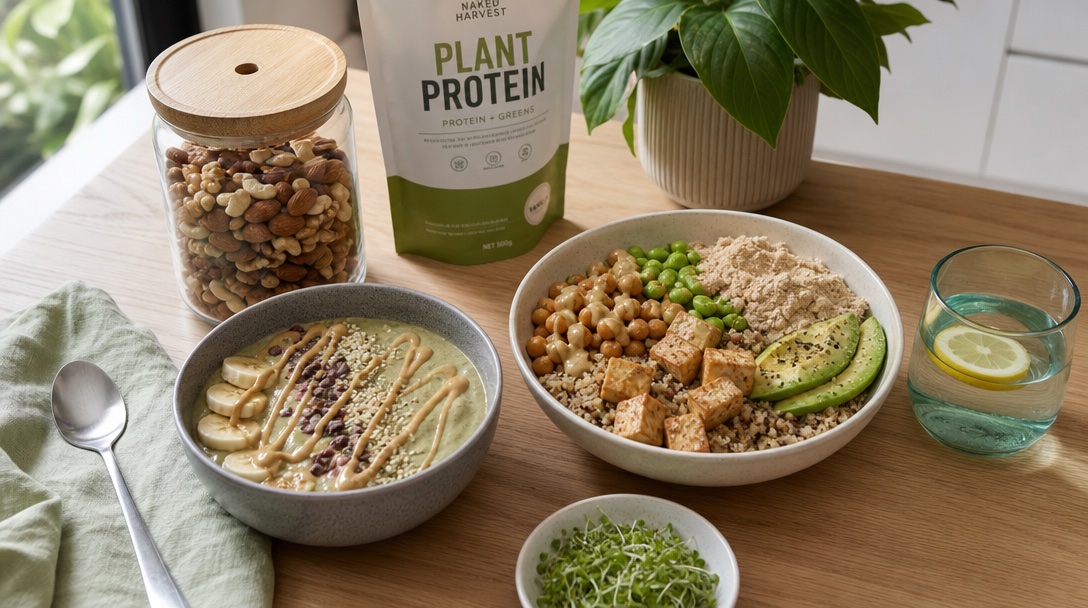
Building Muscle on a Vegan Diet: The Complete Guide to Plant-Based Gains
Walk into any Australian gym and you'll still hear it: "You can't build muscle on a vegan diet." It's one of the most persistent myths in fitness — and the science says it's wrong.
Australia is home to roughly 700,000 vegans, and a growing slice of them train hard. The question isn't whether plant-based lifters can gain muscle — it's whether they do the three things that make any diet work for muscle: enough total protein, enough leucine to trigger muscle protein synthesis, and enough calories. Get those right and the animal products are optional.
In this guide, we break down the evidence, the numbers, and the practical Australian products that make plant-based gains genuinely simple.
Can You Really Build Muscle Without Meat?
Yes. The most direct evidence comes from a 2021 study published in Sports Medicine by Hevia-Larraín and colleagues, which compared matched groups of habitual vegans and omnivores doing the same 12-week resistance training program. Both groups ate protein-matched diets (1.6g per kg). Result: no significant differences in muscle mass or strength gains between vegans and omnivores.
Earlier research points the same way. A 2015 randomised controlled trial in the Journal of the International Society of Sports Nutrition (Babault et al.) found pea protein supplementation produced identical muscle thickness gains to whey over 12 weeks of training. When protein is matched, the source matters far less than most people assume.
| Study | Design | Result |
|---|---|---|
| Hevia-Larraín et al. (2021), Sports Medicine | 38 trained men, protein-matched vegan vs omnivore diets, 12-week program | No difference in muscle or strength gains |
| Babault et al. (2015), JISSN | RCT, pea protein vs whey vs placebo with resistance training | Pea matched whey for muscle thickness; both beat placebo |
| Morton et al. (2018), BJSM meta-analysis | 49 studies on protein intake & training | ~1.6g/kg/day is the optimal intake, source-agnostic |
The 3 Pillars of Vegan Muscle
Plant-based gains come down to three non-negotiables:
Pillar 1: Total Protein — 1.6 to 2.2g per kg
The evidence is remarkably consistent: 1.6g per kg of bodyweight per day is the sweet spot for resistance-trained individuals, with benefits levelling off around 2.2g. For an 80kg lifter, that's 128–176g of protein daily — a number that requires intention on any diet, but is very achievable plant-based.
Pillar 2: Leucine — The Muscle-Building Trigger
Leucine is the amino acid that actually flips the switch on muscle protein synthesis. Research suggests you need roughly 2–3g of leucine per meal to get a full anabolic response. This is the part of vegan eating that requires the most attention, because plant proteins are generally lower in leucine than whey (about 6–8% of their protein content, versus ~11% for whey).
Pillar 3: Calorie Surplus
You can't build tissue you don't fuel. Vegan food tends to be lower in energy density, so hard gainers often need to be deliberate about adding calories — nut butters, avocado, extra oil, seeds, and smoothies are your friends.
The Leucine Problem (and How to Fix It)
Not all plant proteins are equal. Here's roughly how much leucine you get from a typical serve of common vegan protein sources:
| Food (typical serve) | Protein | Approx. Leucine |
|---|---|---|
| Seitan (100g) | ~25g | ~2.0g |
| Tempeh (100g) | ~19g | ~1.5g |
| Tofu, firm (150g) | ~21g | ~1.7g |
| Pea protein powder (30g scoop) | ~24g | ~1.9g |
| Cooked lentils (1 cup) | ~18g | ~1.3g |
| Cooked chickpeas (1 cup) | ~15g | ~1.0g |
| Hemp seeds (30g) | ~10g | ~0.7g |
The fix is simple: build each meal around soy (tofu, tempeh, edamame), seitan, or a high-quality legume protein powder, rather than relying on grains and nuts alone. Aim for one "leucine-rich" protein at every meal. If a meal is falling short, a scoop of plant protein or a sprinkle of nutritional yeast (about 3g protein and 0.3g leucine per tablespoon) closes the gap.
The Best Plant Protein Powders in Australia (2026)
Australian plant-based lifters are spoilt for choice. Based on our database, here are the standouts and what they cost:
| Product | Size | Price (AUD) | Protein per Serve | Notes |
|---|---|---|---|---|
| Bulk Nutrients Plant Protein | 1kg | ~$34.00 | 24g | Aussie-made, cheapest per gram, pea/rice blend |
| MyProtein Vegan Blend (sale) | 1kg | ~$35.00 | 21g | Watch for 40%+ off events |
| Happy Way Vegan Protein | 1kg | ~$49.95 | 25g | Sydney brand, big flavour range, great texture |
| Macro Mike Plant Protein | 1kg | ~$59.95 | 20g | Premium Australian, sweetener-free options |
| Prana On Vegan Protein | 1kg | ~$49.00 | 24g | Gold Coast brand, clean label |
ProteinRanked tip: compare cost per gram of protein, not price per tub. Bulk Nutrients' Plant Protein works out to roughly $0.57 per 25g of protein — cheaper than almost every whey product in the country, and a solid pea/rice blend delivers the full amino acid picture.
What About Soy?
If you're vegan, soy is your best friend — and it's also the most misunderstood food in the gym. The fear that soy lowers testosterone is not supported by the evidence. Multiple systematic reviews have found no meaningful effect of soy foods or isoflavones on testosterone levels in men, and soy protein has been shown repeatedly to support muscle growth equivalent to other protein sources. Tofu, tempeh and edamame have been eaten safely at scale for centuries.
The regulatory view in Australia is the same: FSANZ considers soy foods safe for general consumption, and no public health body has found reason to limit them.
A Sample High-Protein Vegan Day (for an 80kg Lifter)
Target: ~160g of protein (2g/kg). This is what hitting the number actually looks like:
| Meal | Foods | Protein |
|---|---|---|
| Breakfast | Smoothie: 1 scoop plant protein, 250ml soy milk, oats, 1 tbsp peanut butter | ~42g |
| Lunch | 150g tempeh stir-fry with rice and veggies | ~35g |
| Snack | 1 cup edamame + small handful of almonds | ~24g |
| Post-workout | 1.5 scoops plant protein with soy milk | ~45g |
| Dinner | Lentil bolognese (100g dried lentils) with nutritional yeast | ~28g |
| Total | ~174g |
Swap in seitan, tofu or chickpea-based dishes and you have endless variety. The structure is the point: a leucine-rich protein at every meal, whole foods doing the heavy lifting, and powder used to top up — not as the foundation.
Supplements Worth Considering (and Ignoring)
- Creatine — genuinely worth it. Vegans have about 30–40% lower baseline muscle creatine than omnivores (because creatine is found almost exclusively in meat), so supplementation provides a bigger relative response. 5g daily, standard dose.
- Vitamin B12 — non-negotiable. Not optional on a fully plant-based diet. A daily supplement or fortified foods.
- Omega-3 (algae-based) — optional but sensible if you're not getting ALA-rich seeds daily.
- Iron and zinc — test, don't guess. Plant iron is less bioavailable; if you're tired and vegan, get levels checked rather than self-supplementing.
- Mass gainers — skip. The same rule applies as for omnivores: you're paying for maltodextrin. Make a smoothie instead.
The Bottom Line
Muscle doesn't care whether your protein came from a cow or a chickpea — it cares about total intake, leucine, and training stimulus. The evidence is clear that protein-matched vegan diets build muscle just as well as omnivorous ones, and Australia now has an excellent lineup of affordable, high-quality plant proteins (with Bulk Nutrients and Prana On leading the value pack).
Your plant-based gains checklist:
- Hit 1.6–2.2g of protein per kg — every day, not just training days
- Include a leucine-rich source at every meal — soy, seitan, or plant protein
- Eat in a modest surplus if you want to gain
- Take creatine — your starting point is lower, so the response is bigger
- Don't skip B12, and get iron/zinc checked if energy dips
Do those five things and your plant-based diet stops being an obstacle and becomes exactly what it should be: a way of eating that fuels serious, measurable progress in the gym.
Ready to find the right plant protein for your goals and budget? Run the ProteinRanked comparison — we do the price-per-gram math so you can train hard and never overpay.
Last updated 2026-08-31. This article was researched and published by the ProteinRanked Team based on peer-reviewed sports nutrition literature. Prices are indicative of the Australian market as of August 2026 and may vary by retailer and promotion. For personalised nutrition advice, consult an Accredited Practising Dietitian (APD).