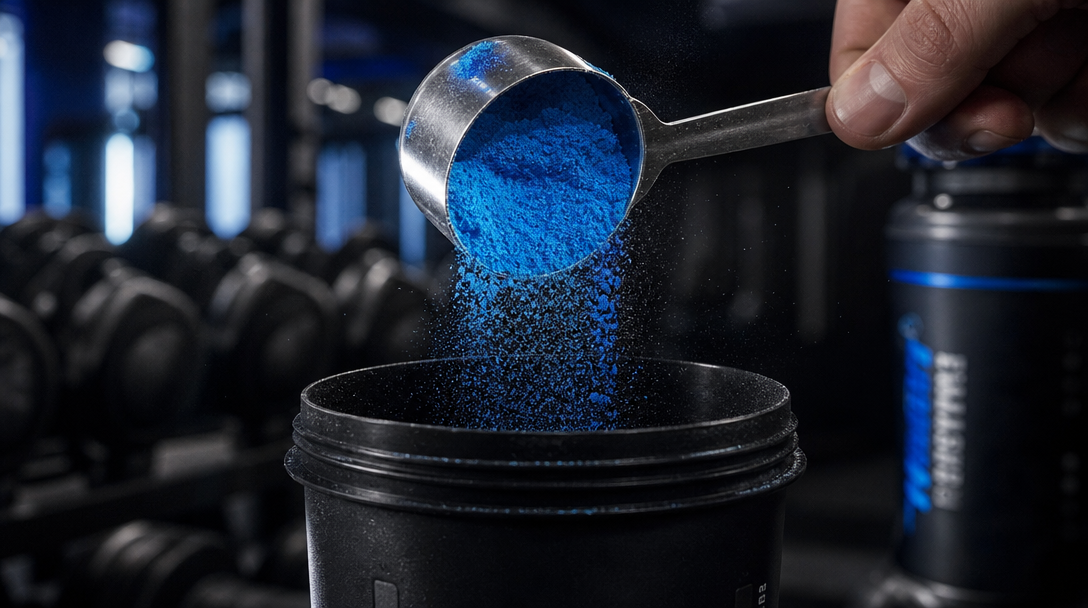
Pre-Workout Ingredients Decoded: What's Actually Doing the Work?
Walk down the supplement aisle at any Australian retailer — Elite Supps, Mr Supplement, or the ever-growing pre-workout wall at your local gym — and you'll find tubs promising "laser focus", "skin-splitting pumps", and "explosive energy" for $50 to $90 a pop. Flip one over and you'll find a label with anywhere from six to twenty-five ingredients, most with names that sound like they belong in a chemistry lab.
Here's the uncomfortable truth the supplement industry would rather you didn't examine too closely: the overwhelming majority of what you feel from a pre-workout comes from one or two ingredients — and the rest is often filler, fairy dust dosing, or marketing in powder form.
In this guide, we decode every common pre-workout ingredient, show you what the research actually says, and help you work out whether that $70 tub is worth it or whether you'd be better off buying the ingredients separately.
The One Ingredient Doing All the Work
Caffeine: the only stimulant that matters
Caffeine is the engine of virtually every pre-workout on the Australian market — and it's also the cheapest, most researched performance enhancer in existence.
The evidence is unambiguous. Doses of 3–6 mg per kilogram of body mass (roughly 210–420 mg for a 70 kg lifter) reliably improve muscular endurance, time to exhaustion, and perceived effort. Caffeine works by blocking adenosine receptors, blunting your perception of fatigue and effort. That's the "I feel like a machine" effect from your pre-workout. It's not the exotic South American berry extract. It's a molecule you can get from a $0.30 coffee.
The practical numbers:
- Effective dose: 150–300 mg for most people (about 1–2 strong coffees)
- Peak effect: 30–60 minutes after ingestion
- Half-life: 4–6 hours — which is why a 6pm pre-workout can wreck your sleep (a real issue for Australian gym-goers who train after work; poor sleep will cost you more gains than any pre-workout can deliver)
- Tolerance: regular caffeine users get blunted effects, leading to dose creep — a cycle worth avoiding
Red flag to watch for: labels that list caffeine as part of an "energy blend" without a milligram figure. If a brand won't tell you how much caffeine is in the scoop, don't put the scoop in your body.
The Genuinely Useful Supporting Cast
Beta-alanine: the tingle with real evidence
That pins-and-needles sensation (paresthesia) isn't an allergy — it's beta-alanine, and it's one of the few pre-workout ingredients with a solid evidence base.
Beta-alanine is the rate-limiting precursor to carnosine, a molecule your muscles use to buffer acid produced during high-intensity exercise. Meta-analyses show that 3.2–6.4 g per day, taken consistently for several weeks, modestly improves endurance in the 60–240 second range — think 400 m sprints, high-rep sets, CrossFit-style Metcons, or the last few reps of a 15-rep set.
Two caveats:
- It's a chronic supplement, not acute. A single scoop 30 minutes before training does almost nothing. The carnosine loading happens over weeks of daily use. Ironically, the tingles are the immediate effect, and the performance benefit is the invisible one.
- It doesn't help maximal strength. If you're a powerlifter doing sets of 1–5 reps, beta-alanine is largely irrelevant.
A fair Australian price for beta-alanine alone is around $25–35 for a month's supply from bulk suppliers like Bulk Nutrients — far less than you'd pay for it bundled in a branded tub.
Citrulline malate: the closest thing to a real "pump" ingredient
Most pre-workout "pump blends" are built on L-citrulline or citrulline malate, and unlike most pump claims, this one has plausible research behind it.
Citrulline converts to arginine in the kidneys, boosting nitric oxide production, which widens blood vessels and increases blood flow to working muscle. Studies suggest 6–8 g of citrulline malate taken 40–60 minutes pre-workout can modestly improve training volume and reduce soreness in the days after a session.
The critical catch: dosing. Effective studies use 6–8 g. Many commercial pre-workouts include 1–3 g — enough to print "contains citrulline" on the label, not enough to do anything. Check your label against that range before you pay a premium for the word "pump".
Creatine: great supplement, wrong product
Some pre-workouts now include creatine "for strength". Creatine is arguably the best-studied sports supplement ever made — but the 1–2 g crammed into a pre-workout is roughly a third of the effective daily dose of 3–5 g, and the timing doesn't matter (as we covered in our creatine vs pre-workout comparison). You're paying pre-workout prices for an underdosed ingredient you should be buying separately for about $20 a kilo.
The Grey Zone: Modest Evidence at Best
- Betaine (TMG): some evidence for small strength improvements at 2.5 g/day, but findings are inconsistent. Not useless, not proven.
- L-tyrosine: acute doses (500–2,000 mg) may support cognitive performance under stress (sleep deprivation, cold, military contexts). For a well-rested lifter at 6pm? Marginal.
- Taurine: a genuine cellular regulator with interesting long-term health research, but single pre-workout doses have little acute benefit for training.
- Alpha-GPC: some evidence for power output at high doses (300 mg+); again, frequently underdosed in commercial blends.
None of these are dangerous, and none are worthless. But at typical label doses, none of them will be the difference between a good session and a bad one.
The Filler: What to Stop Paying For
BCAAs and EAAs in your pre-workout
We've covered the BCAA vs EAA debate in depth, but the short version: if you're eating adequate protein — and if you're reading a protein comparison site, you probably are — aminos in your pre-workout do essentially nothing. They're a cheap ingredient that makes an ingredient panel look longer and more "sciencey". Skip.
"Proprietary blends"
Any label that says "Focus Matrix — 4.2 g" instead of listing individual doses is telling you something: the company is hiding the doses for a reason. Reputable brands list exact quantities. If you can't verify the dose, you can't verify the value.
Glucose disposal agents, "absorption enhancers", exotic stimulant cocktails
AstraGin, bioengineered enzyme blends, blends of three overlapping stimulants to disguise a caffeine megadose — these exist to make labels look premium. The research behind them is thin to nonexistent at label doses.
The Scoreboard: Every Common Ingredient at a Glance
| Ingredient | Effective dose | Evidence | Verdict |
|---|---|---|---|
| Caffeine | 150–300 mg | Very strong | The whole show — worth it |
| Beta-alanine | 3.2–6.4 g daily (chronic) | Strong for 1–4 min efforts | Worth it, buy separately if on a budget |
| Citrulline malate | 6–8 g pre-workout | Moderate | Worth it if dosed properly (rare) |
| Creatine | 3–5 g daily | Very strong | Buy separately — always underdosed in pre-workouts |
| Betaine | 2.5 g daily | Mixed | Optional |
| L-tyrosine | 500–2,000 mg | Situational | Skip unless training fasted/stressed |
| Taurine | 1–3 g | Weak acute effect | Skip |
| BCAAs/EAAs | 5–10 g | Negligible with adequate protein | Filler |
| "Proprietary blend" | Unlisted | Unverifiable | Red flag — avoid |
Prices and typical doses based on Australian retail at time of writing.
What a Fair Price Looks Like in Australia
Here's the part the industry really doesn't want you to do — the maths:
- Caffeine tablets: 100 × 200 mg tablets cost about $15 at Australian pharmacies and online. That's two years of training sessions.
- Beta-alanine: ~$30 for 500 g from bulk Australian suppliers like Bulk Nutrients — over five months of daily 3 g serves.
- Citrulline malate: ~$40 for 500 g of bulk powder — over 60 properly-dosed 8 g serves.
- Total DIY stack: roughly $0.90–1.30 per session, fully dosed, no filler.
Compare that to a $70 branded tub at 30 serves: $2.30+ per serve, often underdosed on the ingredients that matter, and padded with the ones that don't.
A branded pre-workout makes sense for one reason: convenience and taste. If you value a pre-mixed, decent-tasting scoop and don't want three tubs of raw powder on your kitchen bench, that's a legitimate choice — we've all been there. Just choose a brand that lists full doses, and check the caffeine content against your actual tolerance.
How to Read Your Label: A 30-Second Checklist
- Find the caffeine number. No number? Put it back. Above 350 mg per serve? Only if you genuinely tolerate it.
- Check citrulline against 6–8 g. Below that, the "pump" claim is marketing.
- Check beta-alanine against 3.2 g minimum — and remember it only works with daily use.
- Look for a full-disclosure label with exact mg/g figures, not blended totals.
- Ignore anything you can't pronounce unless it has a number next to it. No dose, no effect.
The ProteinRanked Verdict
Pre-workouts aren't a scam — but they're rarely good value per ingredient. The honest hierarchy is:
- Sleep and nutrition (free, biggest effect)
- Caffeine (cheap, proven)
- Creatine monohydrate (~$20/kg, proven — buy it separately)
- Beta-alanine and citrulline (proven for specific situations, best bought in bulk)
- Everything else on the label (mostly noise)
If you love your pre-workout and it lists honest doses, keep enjoying it. But if you're a lifter on a budget in Australia — and given current cost-of-living pressure, most of us are — a pharmacy caffeine tablet, a bulk creatine tub, and a coffee 45 minutes before training will outperform most $70 tubs on the shelf. Your body responds to molecules and doses, not label art and brand ambassadors.
Last updated 2026-11-09. This article was researched and published by the ProteinRanked Team. General information only — not medical advice. If you're pregnant, have a heart condition, or are sensitive to stimulants, talk to a healthcare professional before using pre-workout supplements. Caffeine doses above 400 mg/day are not recommended for healthy adults.