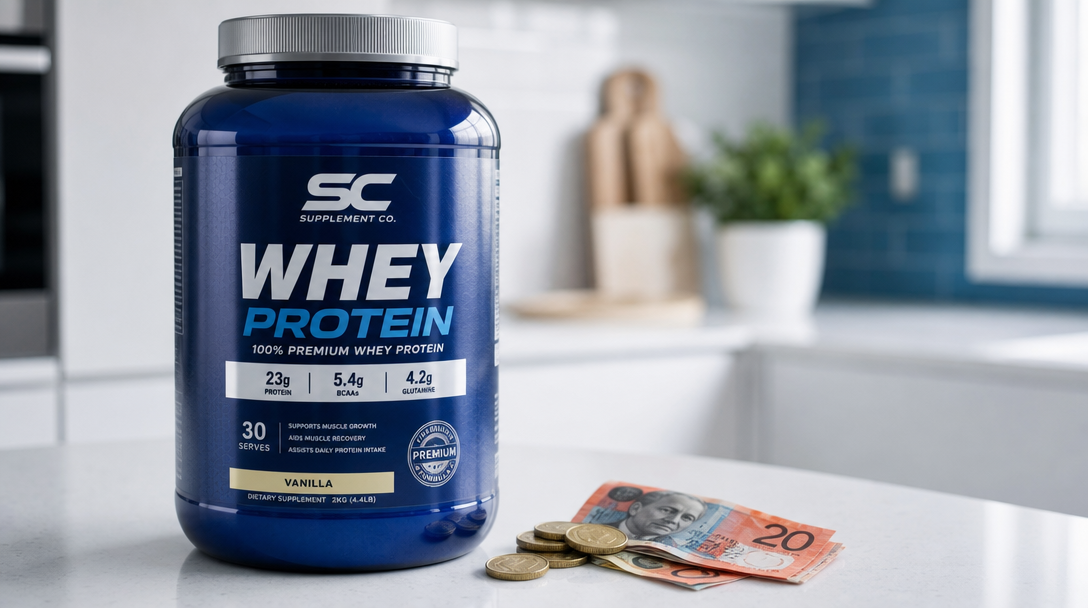
The Price of Protein: Why Australian Whey Costs What It Does
Next time you pick up a 2kg tub of whey protein at an Australian supplement store, take a moment to look at the price tag. Depending on the brand, the retailer, and whether there's a sale sticker on the shelf, that tub could cost you anywhere from $35 to $120 AUD. Same basic ingredient — whey, a byproduct of cheese production — yet a price spread of more than threefold. Why?
The answer isn't simple. The price of a tub of protein powder reflects a long supply chain that starts with dairy farmers in Victoria, runs through processing plants here and overseas, crosses shipping lanes, passes through importers and distributors, and finally lands on a retail shelf — with each hand adding a margin. Understanding that journey helps explain why some brands charge a premium, why others are surprisingly cheap, and where the real value lies.
At ProteinRanked, we track pricing across the Australian market every week. Here's our breakdown of what actually drives the cost of whey protein in Australia.
From Dairy Farm to Protein Powder: The Supply Chain
Step 1: Milk and Cheese Production
Whey protein begins life as milk, and Australia is one of the world's major dairy producers. Roughly 65% of Australia's domestic milk production occurs in Victoria, particularly the Gippsland and Murray regions. When milk is processed into cheese, the curds (solids) become cheese and the liquid that drains off is whey — which contains about 20% of the milk's original protein.
Historically, this liquid whey was waste. Dairies literally poured it down the drain or fed it to pigs. It was only in the 1990s, as sports nutrition boomed, that whey became valuable enough to process commercially. Today, whey protein is arguably more profitable than the cheese it came from.
Step 2: Filtration and Drying
Raw liquid whey contains roughly 0.8% protein by weight. To turn it into a powder, the water must be removed and the protein concentrated. This is done through one of several filtration methods:
- Ultrafiltration produces whey protein concentrate (WPC), typically 80% protein by weight. This is the most common and affordable form.
- Microfiltration and ion exchange produce whey protein isolate (WPI), 90% protein or higher, with most lactose and fat removed. More processing means higher cost.
- Hydrolysis pre-digests the protein into smaller peptides, creating whey protein hydrolysate (WPH). This is the most expensive form and is used in premium recovery products.
Each additional processing step adds cost. A kilogram of WPC80 costs a manufacturer roughly $8–12 AUD in raw material. WPI costs $15–22 AUD per kg. WPH can run $30–50 per kg. These are wholesale prices before any flavouring, packaging, shipping, or retail margin is applied.
Step 3: Flavouring, Blending, and Packaging
Unflavoured whey is functional but not pleasant for most consumers. Brands add flavour systems (cocoa, vanilla, fruit powders), sweeteners (sucralose, stevia, monk fruit), emulsifiers (soy or sunflower lecithin for mixability), and sometimes extra ingredients like digestive enzymes or probiotics.
Packaging is another cost layer. A quality resealable 2kg tub with a tamper-evident seal costs $2–4 per unit at scale. Mylar bags (used by budget brands like MyProtein) are cheaper at $0.50–1.50 per unit, which is part of why bagged protein is often less expensive than tubed.
Step 4: Shipping and Import Costs
This is where the Australian market diverges significantly from the US and Europe.
Australia produces high-quality whey domestically — brands like Bulk Nutrients (Tasmania) and True Protein (Sydney) source locally processed whey. But many of the biggest-selling brands in Australia — Optimum Nutrition, Dymatize, BSN, Rule 1 — are manufactured in the United States or Europe and shipped here.
For imported protein, the cost stack includes:
- International freight: Sea freight for a pallet of protein powder from the US to Australia runs roughly $4–8 per kg. Air freight is faster but 5–10x more expensive, which is why most imported protein arrives by sea.
- Quarantine and biosecurity: The Australian Border Force and Department of Agriculture inspect imported dairy products. Fees, documentation, and potential hold times add $0.50–2 per kg.
- Import duties: Under various free trade agreements (AUSFTA with the US, and pending deals with the EU), most dairy protein powders enter Australia at 0–5% duty. But compliance paperwork still costs money.
- GST: 10% applied at the point of import, based on the customs value plus freight and duty.
By the time an imported tub of Optimum Nutrition lands in an Australian warehouse, the landed cost can be 30–50% higher than the equivalent product on a US shelf.
Step 5: Distribution and Retail Markup
Once the product is in Australia, it moves through a distribution network before reaching you:
- Brand or importer → distributor: Distributors like Australian Sports Nutrition or Elite Supplements' wholesale arm take 15–30% margin.
- Distributor → retailer: Retailers (Chemist Warehouse, Priceline, supplement specialty stores, or the brand's own online store) add another 30–60% margin.
- Online direct-to-consumer: Brands selling through their own websites skip the distributor layer, which is why DTC brands like Bulk Nutrients and MyProtein AU can offer lower prices.
A tub that costs $25 to land in Australia might retail for $60–90, with the difference split between the distributor, the retailer, marketing, and the brand's own profit margin.
Why Some Brands Cost More (And Whether It's Justified)
Premium Brands ($70–120 per 2kg)
Brands like Optimum Nutrition Gold Standard, Rule 1, and Dymatize ISO100 sit at the top of the Australian price ladder. You're paying for:
- Global brand reputation and marketing spend — Optimum Nutrition is owned by Glanbia, a multinational that spends millions on sponsorships and advertising.
- Extensive flavour development — 20+ flavours per product line, each requiring formulation and testing.
- Third-party certification — Informed Sport testing adds cost but provides trust.
- Import overheads — US-manufactured, shipped to Australia.
Is the premium justified? Partially. The protein quality is genuinely excellent, and the consistency is reliable. But you're also paying for brand equity and marketing. A locally produced WPI from Bulk Nutrients delivers equivalent protein quality for 30–40% less.
Mid-Range Brands ($45–70 per kg)
This is the sweet spot for most Australian consumers. Brands like Bulk Nutrients, True Protein, EHPlabs, and Muscle Nation offer good quality at fair prices. Many are Australian-made or at least Australian-owned, which reduces import costs and supports local manufacturing.
Budget Brands ($25–40 per kg)
MyProtein dominates this segment in Australia, often running sales that drop their Impact Whey below $25/kg. The protein quality is solid (84% protein by weight for the concentrate), and the low price comes from:
- Direct-to-consumer model — minimal retail markup
- Mylar bag packaging — cheaper than tubs
- Economies of scale — MyProtein is one of the world's largest supplement brands
- Aggressive promotional strategy — they'd rather sell volume at thin margins
There's nothing wrong with budget whey if the brand is reputable. Just check the label for protein percentage and make sure you're not buying a heavily padded "protein blend" that's mostly fillers.
The Australian-Specific Price Factors
Several factors unique to Australia affect what you pay at the checkout:
Geographic Isolation and Freight
Australia's distance from major manufacturing hubs in the US and Europe means higher shipping costs. Even domestic freight is expensive — moving a pallet from Melbourne to Perth adds $2–4 per kg compared to Melbourne-to-Sydney. This is why some brands charge different prices or offer different stock availability in different states.
The Australian Dollar
Protein powder prices in Australia are sensitive to the AUD/USD exchange rate. When the dollar weakens (as it did in 2022–2023, dropping below 65 US cents), imported protein becomes more expensive almost overnight. Brands typically absorb short-term fluctuations but pass on sustained movements through price increases of 5–10%.
Local Manufacturing Capacity
Australia has a growing but still limited whey processing infrastructure. Most Australian dairy processing is geared toward milk, cheese, and butter — not protein extraction. Brands that process locally (Bulk Nutrients, True Protein) source their raw whey from a small number of domestic suppliers, which limits how much they can scale and how low they can price.
Retail Concentration
The Australian supplement retail market is concentrated among a few major players — Chemist Warehouse, Elite Supplements, Australian Sports Nutrition, and a handful of online-first brands. This concentration gives large retailers negotiating power to push brands on price, but it also means less price competition at the consumer level compared to the fragmented US market.
What You're Actually Paying For: A Cost Breakdown
Here's an approximate cost breakdown for a mid-range 2kg tub of whey protein isolate retailing at $89.95 AUD in Australia:
| Cost Component | Approximate Share | AUD |
|---|---|---|
| Raw whey protein (WPI) | 25% | $22.50 |
| Flavouring, sweeteners, additives | 8% | $7.20 |
| Packaging (tub, lid, label, scoop) | 5% | $4.50 |
| Manufacturing and quality control | 7% | $6.30 |
| International freight and import costs | 10% | $9.00 |
| Distributor margin | 12% | $10.80 |
| Retailer margin | 20% | $18.00 |
| Brand marketing and overhead | 8% | $7.20 |
| Brand profit | 5% | $4.50 |
These figures are illustrative — the exact split varies by brand, origin, and retail channel — but they show the general picture: the protein itself is only about a quarter of what you pay. The rest is the cost of getting it from a dairy farm to your shaker bottle, plus the margins of every business along the way.
How to Get the Best Value for Protein in Australia
Understanding the cost stack reveals where you can save without sacrificing quality:
- Buy direct from Australian manufacturers. Brands like Bulk Nutrients and True Protein skip import costs and distributor margins, passing the savings to you. Their WPI is consistently among the best value in the ProteinRanked database.
- Buy in bulk during sales. MyProtein and Optimum Nutrition run regular flash sales. Stock up when prices drop 30%+ — protein powder has a shelf life of 18–24 months.
- Compare protein per dollar, not price per tub. A 2kg tub at $80 with 90% protein is better value than a 2kg tub at $60 with 70% protein. Use the ProteinRanked comparison engine to normalise for protein content.
- Consider unflavoured protein. You save the cost of flavour systems and can add your own cocoa, fruit, or sweetener. The savings can be 15–25%.
- Don't overpay for "post-workout" or "nighttime" formulas. These are often just whey or casein with a marketing premium. The underlying protein is the same.
The Bottom Line
The price of whey protein in Australia is a story about logistics, manufacturing economics, and market structure — not just the quality of the powder. When you pay $90 for a tub of imported whey, only about $22 of that is the protein itself. The rest covers shipping across the Pacific, import compliance, distributor and retailer margins, brand marketing, and the packaging in your hands.
For Australian consumers, the most cost-effective strategy is straightforward: buy from local manufacturers where possible, stock up during sales, and always compare protein-per-dollar rather than headline price. A $40 bag of Australian-made WPI from Bulk Nutrients delivers more actual protein than a $90 imported tub — not because the imported product is bad, but because you're not paying for shipping, distributor markups, and global marketing campaigns.
At ProteinRanked, we'll keep tracking the numbers so you don't have to. The cheapest protein isn't always the best, and the most expensive isn't always worth it. The truth is in the data — and now you know how to read it.
Last updated 2026-07-13. This article was researched and published by the ProteinRanked Team based on industry pricing data and supply chain analysis. Prices reflect the Australian retail market as of July 2026 and may vary by retailer and promotion. For personalised nutrition advice, consult an Accredited Practising Dietitian (APD).